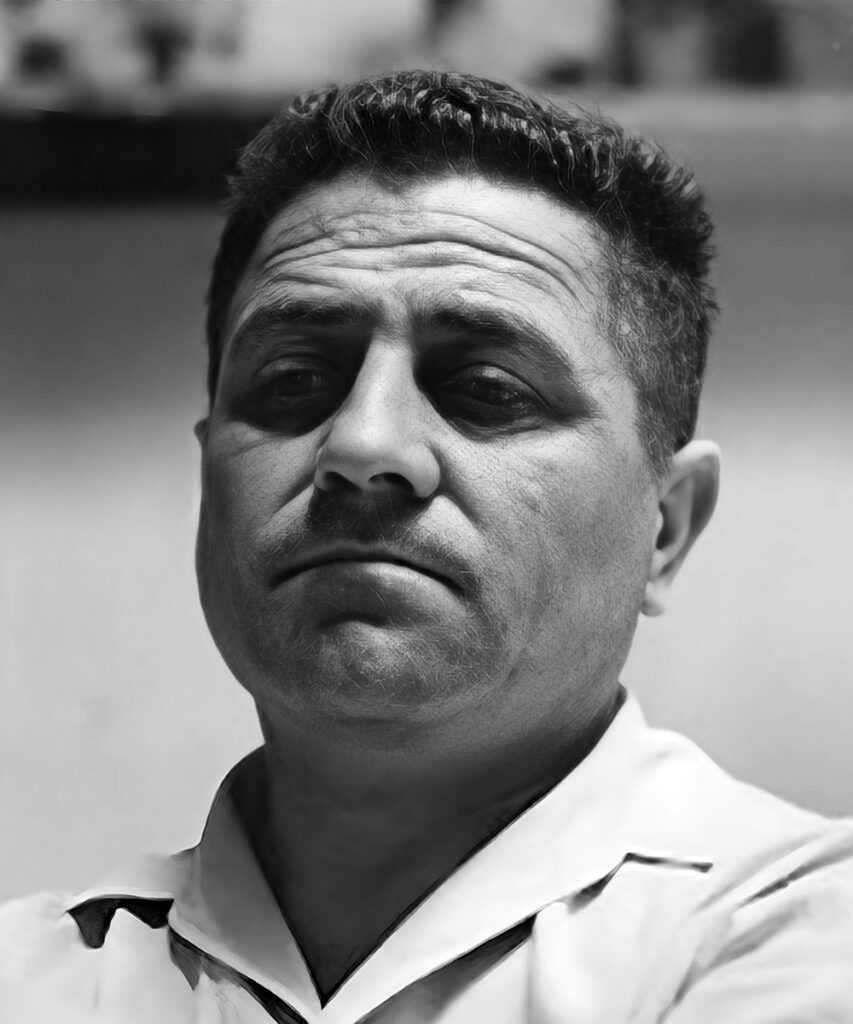
Jozef Mazán
(1920 – 2007)
Academic sculptor Jozef Mazan was born on 11 January 1920 in the village of Čata, in the Levice district. He grew up in his native village, in the “lowlands” region; his father worked as a labourer at the Pohronský sugar refinery. When he was dismissed from work in 1922 for political reasons, he found employment as a miner in Handlová, where the whole family relocated. J. Mazan attended primary school and civic school in Handlová. He began modelling from clay already in primary school; in the 5th grade, at the suggestion of his teacher, he created a bust of Štefánik. He went on to study at the grammar school in Prievidza, where drawing and painting was taught by academic painter Umlášek from Moravia, who would take him out to paint in the surrounding countryside — and so he acquired the fundamentals of landscape painting. On the basis of submitted works and Umlášek’s recommendation, Jozef was accepted into the State Central School of the Furniture Industry in Prague, in the department of artistic wood carving, which he completed with excellent results in 1939. After the Germans closed the universities in Prague, J. Mazan briefly went to Zlín, where he studied at the School of Arts founded there in 1939 by J. A. Baťa.
As early as November 1939 he came to Bratislava to study at the Technical University, in the drawing and painting department under Professor and academic painter Ján Mudroch, who would later become rector of the new Academy of Music and Dramatic Arts. He was one of the first students of the newly established Academy of Fine Arts and Design in Slovakia. He completed drawing and figure painting under Mudroch (1939–1942) and a one-year scholarship stay at the Akademie der Bildenden Künste in Munich (1942) under Professor Josef Thorak, under whom he also studied privately in his studio near Munich (including carving from Carrara marble).
At the Institute of Monumental Sculpture he was taught by academic sculptor Ján Koniarek and Jozef Kostka, who served there as an assistant.
A few examples from the sculptural work of Jozef Mazan: he created several memorials to the Slovak National Uprising — in Nemecká, Dolné Hámre, Oslany, Cigel, Nováky and elsewhere — works with working-class themes, the ornamental sculptural decoration of the ceiling beneath the balconies in the P. O. Hviezdoslav Theatre, and the ornamental decoration of the Nová scéna theatre in Bratislava. His works adorn, besides galleries and museums, also the interiors of the Ministry of Culture of the Slovak Republic, the Ministry of the Interior of the Slovak Republic, and the Faculty of Medicine of Comenius University in Bratislava.
In Handlová there is a bronze group sculpture — the Monument to the Miners. In 1967 the sculpture was placed on Hladové Square, from where it was relocated in 2009 to Ul. 29. augusta. Since 2010, a nationwide commemorative event in honour of the victims of mining disasters in the Slovak Republic has been held there every year on 10 August — the Day of the White Roses.
In Prievidza, on Jozef Cíger Hronský Square, stands the bronze group sculpture Family, also known as Return from Battle (1965).
Jozef Mazan lived in Banská Štiavnica. He died on 6 March 2007 in Bratislava.