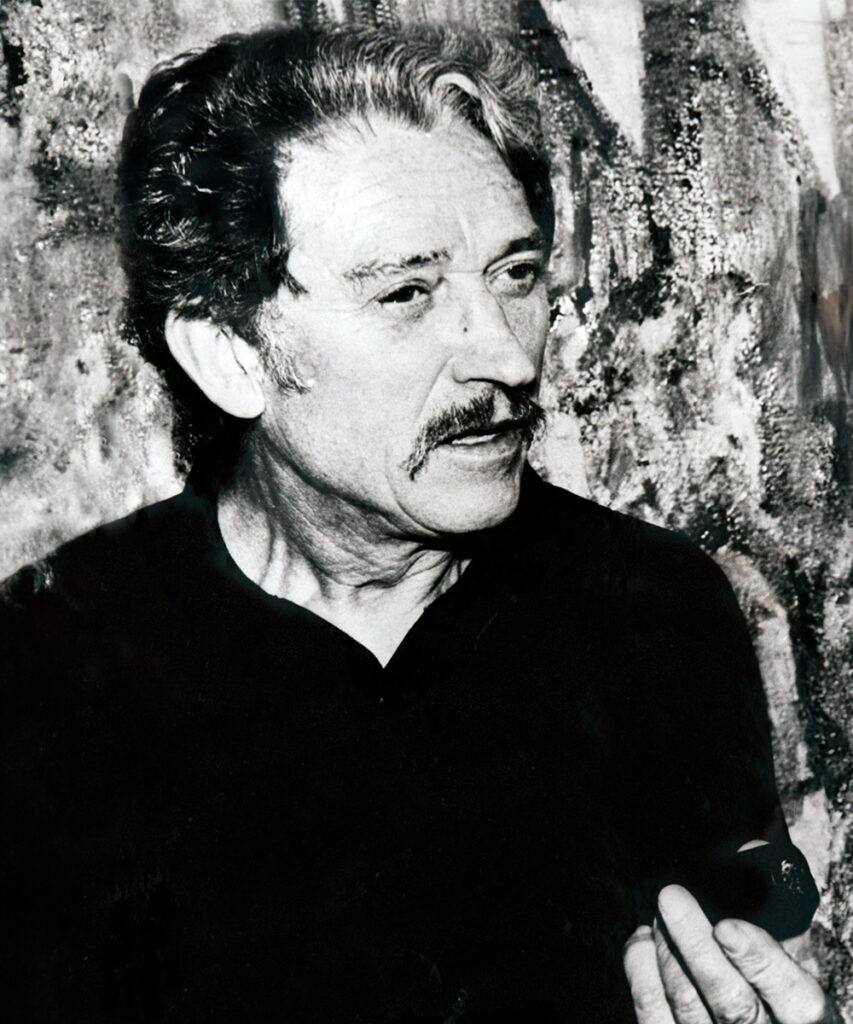
Jozef Fedora
(1910 – 1975)
Jozef Fedora was a painter, graphic artist, architect and art educator. He was born on 8 March 1910 in Dolné Kočkovce.
He studied at a grammar school in Nymburk, then architecture, civil engineering, drawing and descriptive geometry at the Czech Technical University in Prague. From 1937 he was a grammar school teacher in Prievidza and Nitra; from 1959 to 1965 he worked at the Pedagogical Institute in Martin, and from 1965 in Banská Bystrica. He was a participant in the Slovak National Uprising, was arrested by the Gestapo and imprisoned in the concentration camps of Dachau, Buchenwald and others.
He painted portraits, figurative subjects, landscapes and still lifes. He contributed to cultural, political and satirical journals. He is buried in Prievidza.
His works include Know Your Homeland (a cycle of woodcuts, 1932); A Nation of Musicians (linocut, 1932); Bouquet and Woman (gouache, 1939); Outlaws Dancing (pastel, 1944); From the Concentration Camp (ink, 1945); The Construction of Prievidza (gouache, 1956, Slovak National Gallery); Witnesses Must Not Stay Silent, Banská Bystrica in 1962…
Fedora played a significant role in the development of the Píly housing estate. In 1948, an Advisory Board for the Preparation of City Development Plans was established in Prievidza — also known as the Regional Plan Commission — and Jozef Fedora became its chairman. He made use of his knowledge, talent and contacts in institutions in Bohemia (the Brno University of Technology and others). Of the original plan, it was the construction of the Píly housing estate that was realised most faithfully, beginning in 1950 and completed in 1962. The artistic embellishment of the buildings in the SORELA style was carried out over just three years: 1955–1958. In the first phase of the sgrafito decoration in 1955, Fedora was the sole artist working on the works.
He died on 26 September 1975 in Zvolen and is buried in Prievidza.
His works can be seen on Svätoplukova Street (a figure of a miner, circular medallions with miners’ hammers), Fr. Madvu, Björnsona, Krajná, Vnútorná, A. H. Gavloviča, Súbežná, Malá, Benického and Štefánikova streets.