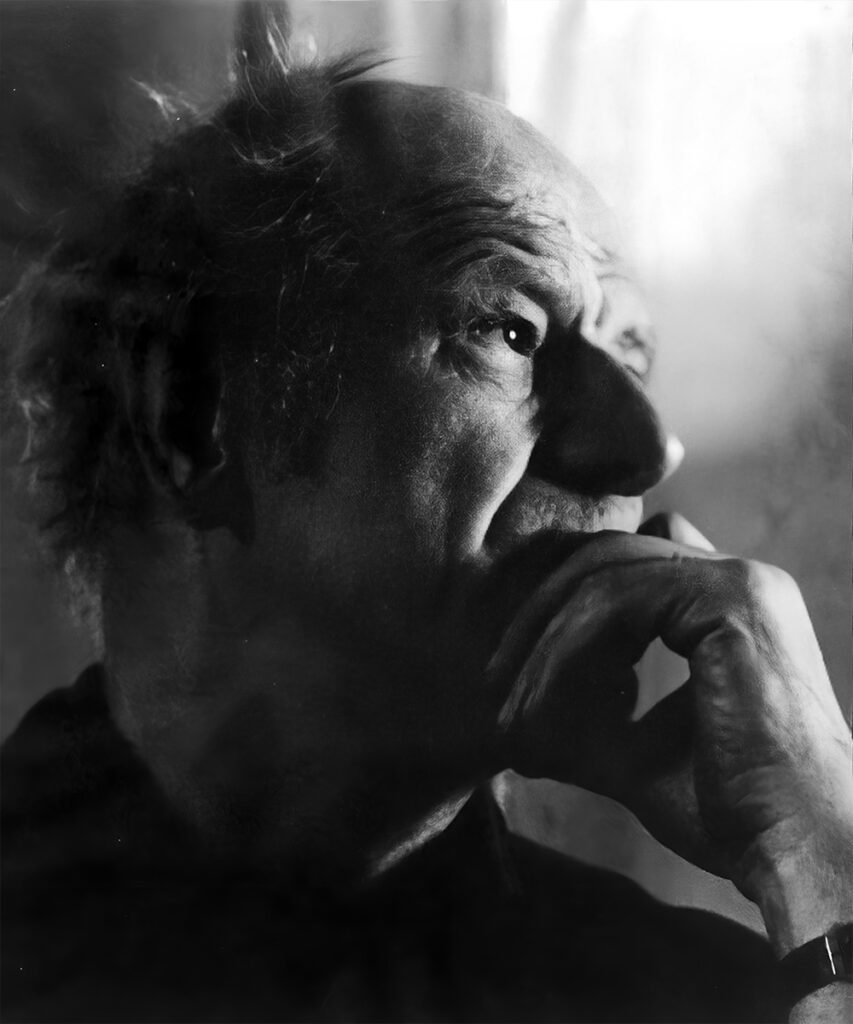
Alexander Trizuliak
(1921 – 1990)
Assoc. Prof. Alexander Trizuljak was born on 15 May 1921 in Varín. He was a sculptor, educator and organiser of artistic life in Slovakia.
His father was a farmer, and although there were nine children in the family, he placed great importance on providing a quality education for his three sons. They were the first from their village to attend secondary schools and later go on to earn university degrees.
During his studies at the grammar school in Žilina, his classmate was Vincent Hložník. In 1943–1944 he studied at the Slovak University of Technology in Bratislava, in the fine arts department under M. Schurmann and J. Kostka, and from 1945–1949 he studied sculpture at the Academy of Fine Arts in Prague under K. Pokorný.
He helped found the Academy of Fine Arts and Design in Bratislava, where he worked as a lecturer from 1949 to 1972. In 1964 he was awarded the title of associate professor.
From the very beginning of his work, Christian motifs were an integral part of it — for example, the Immaculate Conception placed in the church in Spišská Belá, and the Holy Sepulchre in Varín. The culmination of this part of his oeuvre, and a kind of public declaration of faith, was the sculpture of the Crucified Christ in the church in Lamač, Bratislava.
Following genre works on the themes of love, motherhood, happiness and suffering, in the 1950s he created several large-scale sculptures (e.g. Detvan in Prievidza), through which he honed his sense for the monumental arrangement of sculptural mass — a skill he later applied when conceiving his most famous work. This is the 7-metre statue of a Soviet soldier raising a flag, entitled Victory, atop the 39.5-metre-high obelisk of Bratislava’s Slavín, which forms the central part of the memorial built between 1957 and 1960. The Memorial of Victory over Fascism and the Liberation of Bratislava was ceremonially unveiled on 4 April 1960. In terms of its significance, dimensions, technical and artistic conception, it remains unrivalled to this day in the history of Slovak sculpture. (The architectural design was created by architect Ján Svetlík. Leading Slovak sculptors contributed to the decoration of the complex — Alexander Trizuljak, Jozef Kostka, Rudolf Pribiš, Tibor Bártfay, Ján Kulich, Dezider Castiglione, Juraj Kren and Ladislav Snopek.)
In the 1950s, numerous state commissions in the style of socialist realism gave Trizuljak the opportunity to design sculptures for public spaces on a monumental scale. His priority was creative work and the possibilities that the spirit of the era offered him. Architectural works that were springing up like mushrooms at the time were often complemented by sculptural pieces. Artists and sculptors could not complain of a lack of work.
In the early 1960s, a new developmental phase became established in Trizuljak’s work — the use of metals, the artistic application of metal technical elements in decorative-constructivist arrangements with strong spatial and symbolic imagery (Horses, Lovers, Thought, Rocket Machine, Flower). In 1969, the state sent him to Rome as a member of a cultural delegation on the occasion of the 1,100th anniversary of the death of Saint Cyril. Paradoxically, in 1972 Trizuljak was given one hour’s notice of dismissal from the Academy of Fine Arts and Design due to his religious beliefs and contacts. During the period of normalisation, he was pushed out of public life and continued his work in seclusion as a freelance artist. When he was forbidden to create, he found his path in sacred art. Through contacts with priests, he focused on sacred art and commissions related to liturgical spaces. Together with Vincent Hložník, their work left its mark on more than 20 churches across Slovakia. Trizuljak moved from realism to modernism in the spirit of constructivism and lyricism. During this period he experimented, for example, with aluminium mosaic, and the creation of these structures became his personal area of expertise. An example from this phase of his work is the glass sculpture of the Risen Christ, made from golden-yellow topaz glass, in the church in Zeleneč near Trnava. Sacred art was therefore not merely a necessary substitute for lost state commissions, but a fully-fledged and productive stage of his artistic development. In the 1980s he was partially rehabilitated, and Trizuljak again gained access to public commissions. One of his last was the monumental relief on the façade of the Supreme Court in Bratislava.
Trizuljak played a key role in founding several Slovak galleries, including the City Gallery of Bratislava and galleries in Trenčín, Nitra and Humenné. He was present at the birth of Slovak secondary art schools. On his initiative, the Slovak Fund of Fine Arts was established, as well as the now-defunct Arts and Crafts workshops in Bratislava. He founded the tradition of the regular sculptural event Sculpture of the Piešťany Parks, which began with his solo exhibition in Piešťany in 1961. He was also the founder of the Symposium in Metal in Košice and symposia in painting and wood at the manor house in Moravany nad Váhom.
In Prievidza, his work Detvan (1957) can be found on Svätoplukova Street.
Alexander Trizuljak died on 15 October 1990 in Bratislava.
Assoc. Prof. Alexander Trizuljak was born on 15 May 1921 in Varín. He was a sculptor, educator and organiser of artistic life in Slovakia.